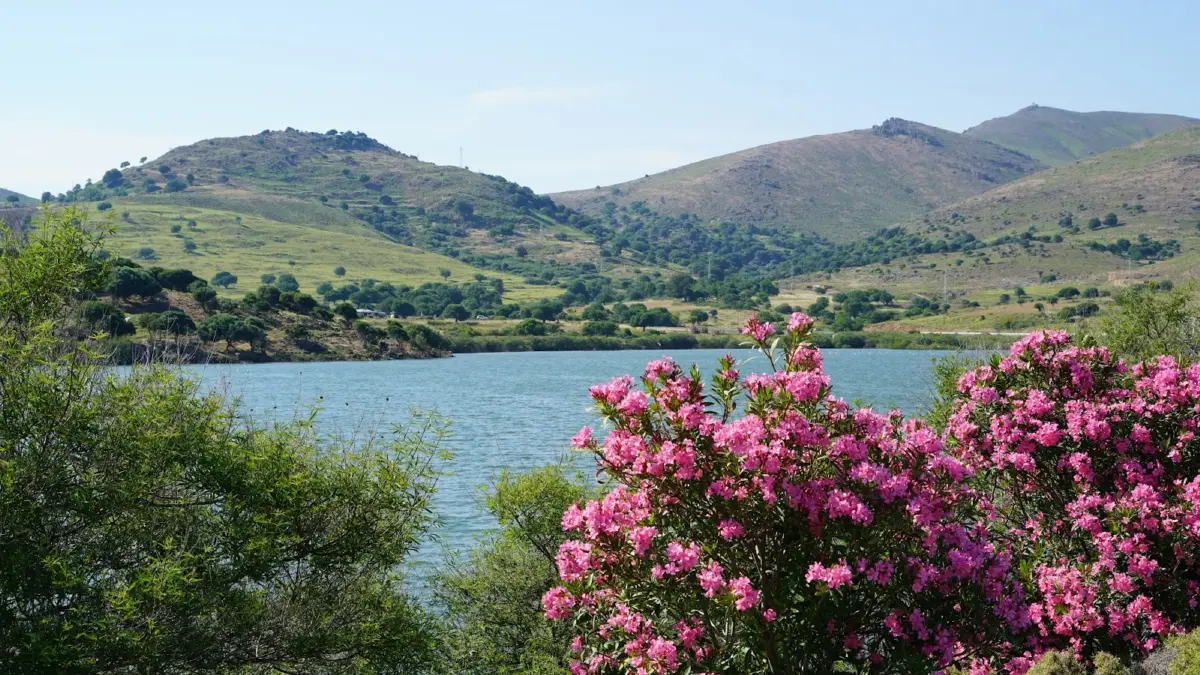
Gökçeada's Flora: The Green Aegean Island with 700+ Species
- Over 700 plant species have been recorded on Gökçeada
- The island has 255,000 olive trees; the Ladolia variety grows only here in Turkey
- IUCN Endangered sea daffodils thrive on the dunes
- Around Tuz Gölü (Salt Lake), 194 terrestrial and 134 aquatic plant species are documented
- Best observation times: April–May (blooming) and September–October (harvest season)
When you set out for a morning walk around the end of March on Gökçeada, a sharp scent rises from the earth — a blend of rockrose, thyme, and mastic tree. In every corner of the island, a different plant greets you. I grew up with these scents, and I can say that Imbros' green is as much a part of its identity as the blue of its sea.
Last November, while picking olives, an elderly neighbor pointed to a branch and said, "This tree is older than both my father and me." He was right — some olives have been standing for a thousand years. That's the kind of nature this island lives in.
The Island of Maquis: Gökçeada's Dominant Vegetation
Gökçeada's main character is maquis formation. Located in the Mediterranean climate zone, the island is covered with evergreen shrub species. Dense maquis is prominent on southern slopes and low-altitude areas. It also spreads as secondary vegetation in areas where forests have been degraded.
The main maquis species you'll encounter on the island include:
- Wild olive (Olea europaea var. sylvestris)
- Mastic tree (Pistacia lentiscus)
- Kermes oak (Quercus coccifera)
- Holm oak (Quercus ilex)
- Myrtle (Myrtus communis)
- Bay laurel (Laurus nobilis)
- Tree heath (Erica arborea)
- Rockrose (Cistus sp.)
- Greek strawberry tree (Arbutus andrachne)
- Strawberry tree (Arbutus unedo)
- Prickly juniper (Juniperus oxycedrus)
Then there's "geven" (astragalus). Everyone who lives on the island knows this thorny cover. Don't go for a walk without choosing your shoes carefully — I'm serious. Since the 1960s, free-ranging goats and sheep have contributed to the spread of this formation through grazing. Nature finds its own balance, but human impact shows everywhere.
Olive Forests: The Island's Millennial Heritage
A Green Treasure of 255,000 Trees
When I think of Gökçeada, the first thing that comes to mind is olives. The island has 255,000 olive trees. A quarter of its 30,000 decares of agricultural land is olive groves. Here, olive cultivation is entirely natural — no chemical fertilizers, no pesticides. Even against the olive fly, organic methods like pheromone traps, kaolin clay, and Bordeaux mixture are preferred. There are 159 organic producers on the island, with IMO-certified farms.
Ladolia: The Only Address in Turkey
The Ladolia olive variety grows naturally only in Spain, Italy, Canada, and Turkey. In Turkey, the only natural location is Imbros. In a special area belonging to the Treasury, there are olives believed to be 500 to 1,000 years old. The municipality is working to declare this area a geopark. Cold-pressed olive oil processed on the day of harvest is recognized by gourmets for its "rare and characteristic" aroma.
One winter day, I walked among those ancient olives. Their trunks were too thick for a person to embrace, branches intertwined. Despite centuries of wind, drought, and neglect, they stand tall. Parking is tricky, the path uneven — but none of that matters when you stand beside those trees.
Forests and Vegetation Zones
Turkish Pine Forests and Marmaros
In the northern parts of the island, especially in the uninhabited Marmaros region, dense Turkish pine (Pinus brutia) forests are found. Marmaros Waterfall plunges from a height of 38 meters, creating a valley adorned with oleander flowers. Unlike the island's windy and open landscapes, there is a cool and humid microclimate here. In winter, water flows abundantly; in summer, it diminishes. It is accessible via 7 km of asphalt from the Derekoy-Uğurlu road, followed by a hike.
Oleander is also a familiar face on the island. You'll often encounter it in the Marmaros valley, with its pink, white, and red flowers.
Oak Species and Other Trees
Several oak species grow naturally on Gökçeada: kermes oak (with registered monumental specimens), downy oak, holm oak, and valonia oak. Alongside these, almond, walnut, linden, pomegranate, and black mulberry enrich the island's tree diversity.
Based on altitude, four main vegetation zones can be distinguished on the island:
| Zone | Altitude | Characteristic Species |
|---|---|---|
| Coastal zone | 0–50 m | Dune plants, halophytes |
| Low maquis | 50–200 m | Kermes oak, myrtle, mastic, rockrose |
| High maquis / forest transition | 200–400 m | Holm oak, downy oak, Turkish pine |
| Forest zone | 400+ m | Turkish pine forests (northern slopes) |
Endemic Species, Dune Plants, and Tuz Gölü
Sea Daffodil: The Island's Fragile Beauty
On Gökçeada's coasts, 87 dune plant species have been recorded. The most striking among them is the sea daffodil (Pancratium maritimum). Classified as "Endangered" by the IUCN, this species is prohibited from being collected from the wild and exported in Turkey. The Ministry of Environment also runs a monitoring project. Psammophilous species like round sedge and Aethorhiza bulbosa are also common on the dunes. Remember that picking these plants is forbidden.
The Hidden World of Tuz Gölü
Tuz Gölü (Salt Lake) in Aydıncık is one of the island's most important wetlands. Around it, 194 terrestrial and 134 aquatic plant species have been identified. Halophytes adapted to salty soils — such as sea asparagus — find their place here. In summer, as water evaporates, a thin layer of salt remains, creating a completely different landscape. Kefalos Beach and Tuz Gölü also attract migratory birds like flamingos, pelicans, and wild ducks. Spring is ideal for birdwatching.
The marine flora is also rich: 349 species and 22 varieties have been identified on the continental shelf, with red algae dominating at 51 percent.
Medicinal and Aromatic Plants
Seeing neighbors go out to collect thyme is a common sight this season. In the island's maquis and phrygana formations, thyme (Thymus sp.), sage (Salvia sp.), bay laurel, and myrtle grow naturally. Locals dry them for tea, spices, and traditional remedies.
The relationship between beekeeping and vegetation is also interesting. For flower honey, vitex and thyme are key; for forest honey, pine and white thyme in Marmaros are the main nectar sources. Bees travel a distance of 5–7 km. The resin-like secretions of rockrose are valuable in perfumery; the resin of the mastic tree has been used in traditional medicine for centuries.
In autumn, under pine forests and oak shade, mushroom diversity emerges: saffron milk cap, meadow mushroom, parasol mushroom, oyster mushroom, ebishke, and blewit are collected by locals and enter the island's cuisine.
Among Gökçeada's nature activities, plant observation stands out. While exploring Gökçeada's geography, the Marmaros forests, Tuz Gölü surroundings, and village paths are the best observation points. Entry to all natural areas is free. Since public transport on the island is limited, car rental is recommended. At the weekly Farmers' Market on Sundays, you can find local organic products — olives, honey, thyme, cheese. As the only island with the world-renowned Cittaslow (Slow City) title, Gökçeada protects organic farming and natural life. Check ferry schedules to plan your trip to the island. If you wish to stay, browse the Gökçeada Business Guide to find suitable hotels or guesthouses.
Frequently Asked Questions
What type of vegetation dominates Gökçeada?
Under the influence of the Mediterranean climate, maquis formation dominates. Wild olive, mastic tree, kermes oak, myrtle, bay laurel, and tree heath are the most common species. Turkish pine forests also occur in the northern highlands.
How old are the olive trees on Gökçeada?
Olive trees aged 300–400 years are common across the island. In a special area belonging to the Treasury, there are Ladolia olives estimated to be 500 to 1,000 years old. Ladolia is a rare variety that grows only on Gökçeada in Turkey.
When is the best time for plant observation on Gökçeada?
The blooming period of April–May is the most ideal time. September–October offers a different richness as olive harvest and mushroom season. In summer, maquis greenery diminishes, but the northern forests remain cool.
What plants grow around Tuz Gölü on Gökçeada?
Around Tuz Gölü, 194 terrestrial and 134 aquatic plant species have been identified. Halophytes adapted to salty soils — such as sea asparagus — are characteristic of this area. Spring is also ideal for birdwatching.
Can wild herbs and mushrooms be collected on Gökçeada?
Thyme, sage, and linden are collected from the wild by locals. In autumn, species like saffron milk cap, meadow mushroom, and oyster mushroom are found in pine forests. However, picking protected plants like sea daffodil is strictly forbidden.
📍 Marmaros — Harita
📍 Bu Bölgedeki İşletmeler
🍽️ Yeme & İçme
🏷️ Etiketler: